



Reforestation in Virginia
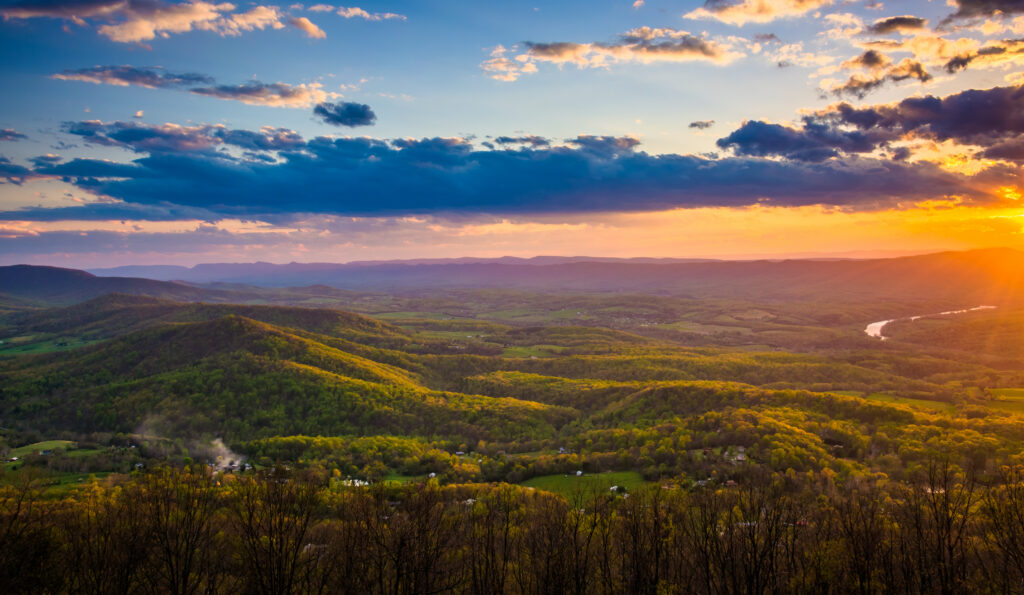
Reforestation in Virginia is a practical investment in working lands, watershed health, and rural communities. The Commonwealth’s forests support one of its largest rural industries, store significant amounts of carbon, protect drinking water sources, and sustain the wildlife and fisheries that drive Virginia’s outdoor recreation economy. Sustaining and growing these benefits requires both replanting forests after harvest and disturbance and expanding the forest base on suitable lands such as marginal pastures, reclaimed mine sites, and riparian zones. Because most of Virginia’s forestland and most of its reforestation opportunity lie in private hands, state programs and partnerships with landowners play a central role in helping landowners replant successfully and delivering durable public benefits across the Commonwealth.
What difference does reforestation make for communities in Virginia?
Forests are a cornerstone of Virginia’s rural economy and support thousands of jobs

108,451 jobs are supported by Virginia’s forest sector.1, 2

Virginia’s forest industry generated $23.6 billion in economic output and $11.3 billion in value-added economic impact in 2021.2

Outdoor recreation contributes $13.4 billion in value-added economic activity and 122,405 jobs in Virginia.4

Hunting supports nearly 10,000 jobs and $1.4 billion in economic impact, while fishing supports about 20,000 jobs and $3.2 billion in economic impact in Virginia.5

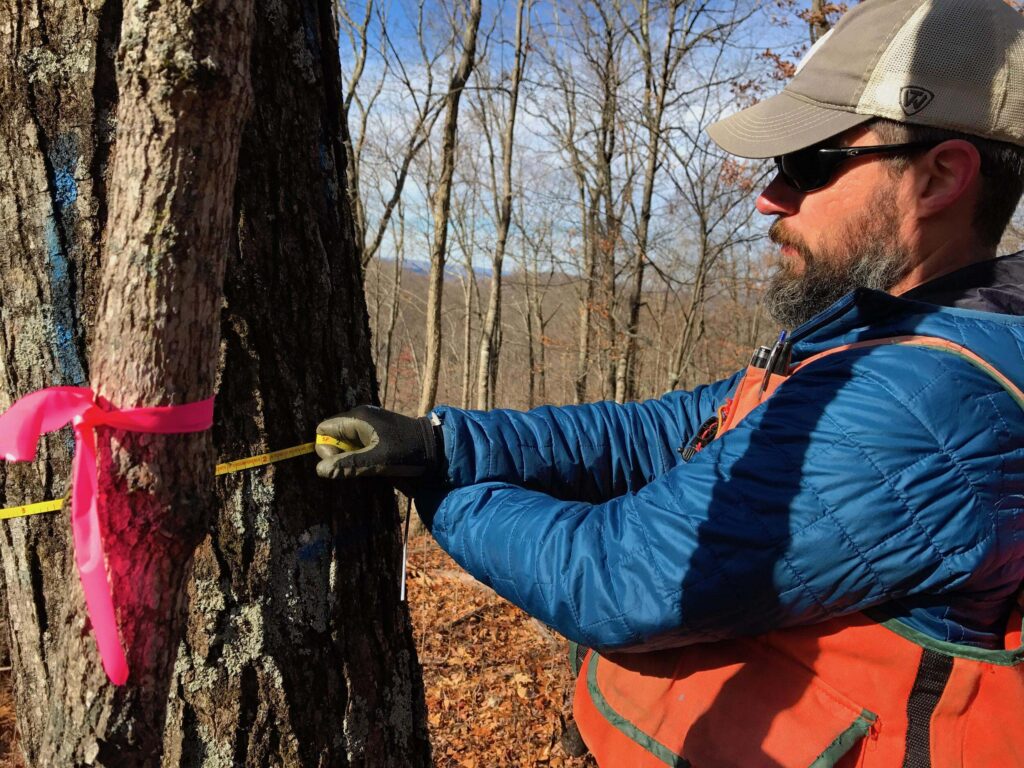
Reforestation helps maintain the forest base that sustains these industries and protects the rural communities that depend on them.
Forests are essential infrastructure for Virginia’s drinking water and watershed health

More than 50% of Virginia’s freshwater resources originate from forests, which cover close to two-thirds of the state.6

Riparian forest buffers reduce nitrogen pollution by 17–56% and phosphorus by 4–20%.7

In Virginia’s Nomini Creek watershed, forested riparian buffers reduced nitrate-nitrogen concentrations in cropland runoff by 48%.8

Reforestation is a core strategy for meeting Virginia’s Chesapeake Bay nutrient reduction commitments and protecting downstream drinking water supplies.11, 12

By slowing storm runoff and improving infiltration, forested watersheds also help reduce downstream flood impacts on communities and infrastructure.9
Reforestation reconnects fragmented forests and rebuilds habitat for wildlife and aquatic animals

Forest loss and fragmentation are among the biggest threats to biodiversity in Virginia.24 Reforestation, especially when it expands or reconnects existing forest blocks, rebuilds core interior habitat and movement corridors, allowing species to migrate, disperse, and maintain genetic diversity.10

Virginia’s Clinch River system, one of the most biologically diverse river systems in North America, depends on healthy forested headwaters to support its rare aquatic species,18 making watershed-scale forest conservation and reforestation a conservation priority.

Forests help naturally remove and store carbon

Virginia’s nearly 16 million acres of forests store approximately 1.47 billion metric tons of carbon, equivalent to roughly 5.4 billion metric tons of CO₂, about 57 years of Virginia’s 2023 energy-related CO₂ emissions.13, 14

Virginia forests currently sequester roughly 40% of statewide carbon emissions annually under current management practices.15

Virginia also has significant potential to expand this carbon sink. Analysis from the Reforestation Hub identifies up to 5.6 million acres of reforestation opportunity in Virginia, about 98% on privately owned land. Reforesting these areas could capture approximately 14 million tons of CO₂ per year, equivalent to removing three million cars from the road annually.16 Together, sustained management of existing forests and expanded reforestation on suitable lands could significantly increase Virginia’s natural carbon sink.


Americans overwhelmingly support practices that expand forest restoration
90% of voters nationwide (85% GOP, 92% IND, 95% DEM) support “providing technical assistance and education to farmers and forest owners so they can learn how to incorporate climate-smart practices on their land.”20
87% of voters nationwide (80% GOP, 88% IND, 93% DEM) support “providing financial incentives and programs for private forest and woodland landowners to sustainably manage their land to keep forests healthy and adopt practices that naturally remove carbon from the air.”20
Source: Survey of 1000 registered voters conducted in June 2024 by bipartisan research team New Bridge Strategy (R) and FM3 Research (D). Commissioned by U.S. Nature4Climate.
How reforestation can be supported and expanded in Virginia:

Expand cost-share for private landowners through the Reforestation of Timberlands (RT) Program.
Virginia’s RT Program provides cost-share assistance to private landowners for site preparation and pine tree planting. It is funded by the forest industry through the Virginia Forest Products Tax and matched by the state’s General Fund, and each year applications are accepted until the available funds are committed. Increased investment would widen participation, especially among the small and medium landowners most constrained by establishment costs.11, 21
Expand riparian forest buffer planting in priority watersheds.
Virginia’s Riparian Forests for Landowners (RFFL) program, launched in 2024, provides turnkey installation and one year of maintenance for riparian forest buffers on private land at no cost to participants.19 In its inaugural year, RFFL established 170 acres of buffers across 85 landowners with $650,800 in funding,19 and now operates on $1.15 million from the Virginia Water Quality Improvement Fund for the 2025–2027 cycle.25 Increased investment could expand the program’s reach where federal programs have been inconsistent, oversubscribed, or geographically limited, targeting tree planting that protects drinking water, reduces erosion, and supports Chesapeake Bay and Southern Rivers watershed goals.7, 21

Expand VDOF nursery capacity to meet growing demand for site-appropriate seedlings.
Virginia’s two state nurseries are entirely self-funded through seedling sales: the Garland Gray Forestry Center in Sussex County (pines) and the Augusta Forestry Center in Crimora (hardwoods and conifers).27 Demand for native hardwoods and riparian-buffer stock is rising, and Augusta has grown its hardwood crop sharply year over year to keep pace.28 But because the nurseries are self-funded, they can invest in staffing and added capacity only as fast as seedling sales allow. Sustained state investment could support staffing, capital improvements, and expanded production of the site-appropriate seedlings, especially native hardwoods, that riparian buffers, biodiversity, and hardwood reforestation require.26

Invest in workforce training and entry pathways for forest operations.
Workforce capacity is increasingly cited as a barrier to scaling reforestation. A 2024 study by the Southern Group of State Foresters found that southern state forestry agencies, including Virginia, have reported persistent struggles filling vacant positions across employment categories, limiting agencies’ ability to implement work tied to available funding.29 The 2025 U.S. Reforestation Capacity Survey similarly identified workforce capacity as one of the leading barriers to scaling reforestation nationally, alongside funding, nursery infrastructure, and seed supply.30 Investment in training and labor capacity, through paid certification programs, partnerships with Virginia’s community college system (including FastForward and G3 programs)31 and Virginia Cooperative Extension, could help ensure existing reforestation programs are able to operate at the scale Virginia’s forests need.

Fund physical protection for seedlings in high deer-browse areas.
White-tailed deer browse can significantly reduce hardwood seedling survival and growth, with oaks and other highly palatable species particularly vulnerable.22 A meta-analysis of 99 studies concluded that fences, tree shelters, and cages are the most effective methods for protecting hardwood seedlings from deer browse, with each method substantially reducing browse incidence and supporting seedling survival.32 These protections add per-acre cost, however, which can deter landowners from including them in reforestation projects. Sustained funding to cover browse protection in high-pressure areas could improve hardwood reforestation success on private lands, including riparian buffers and other native hardwood plantings.

Coordinate reforestation priorities with deer management programs.
Browse impacts on tree regeneration vary by species, seedling size, and local deer density, with highly palatable species (including oaks and maples) experiencing the strongest impacts.33 Virginia’s Department of Wildlife Resources (DWR) already supports forest landowners through the Deer Management Assistance Program (DMAP), which provides technical guidance and targeted harvest opportunities to over 1,000 landowner cooperators.23 Sustained funding could support closer coordination between Virginia Department of Forestry (VDOF) and DWR, including monitoring of browse impact in active reforestation areas and alignment of DMAP enrollment with reforestation priorities, improving outcomes without requiring changes to general hunting regulations.
Click for References
1. U.S. Department of Agriculture Forest Service. (2025). Virginia state & private forestry fact sheet. https://apps.fs.usda.gov/nicportal/temppdf/sfs/naweb/va_std.pdf
2. Weldon Cooper Center for Public Service, University of Virginia. (2022). Virginia forest industry economic impact. https://www.vdacs.virginia.gov/pdf/weldoncooper.pdf
3. Virginia Cooperative Extension. (n.d.). Virginia’s forest economy overview. https://www.pubs.ext.vt.edu/465/465-315/465-315.html
4. U.S. Bureau of Economic Analysis. (2024). Outdoor recreation satellite account: U.S. and states, 2023. https://www.bea.gov/news/2024/outdoor-recreation-satellite-account-us-and-states-2023
5. Virginia Department of Wildlife Resources. (n.d.). Annual report. https://dwr.virginia.gov/about/annual-report/
6. Virginia Department of Forestry. (n.d.). Watershed forestry and freshwater resources. https://dof.virginia.gov/land-water-protection/learn-about-land-water-protection/watershed-forestry/
7. U.S. Department of Agriculture, Farm Service Agency. (2019). Riparian forest buffer final report. https://www.fsa.usda.gov/sites/default/files/documents/CREP-Riparian-Forest-Buffer-FINAL-REPORT.pdf
8. Piedmont Environmental Council. (n.d.). Understanding the science: Riparian buffers and water quality (summary of Snyder et al., 1995). https://www.pecva.org/wp-content/uploads/library/documents/Our-Mission/Clean-Air-and-Water/understanding-the-science-riparian-buffers-wq.pdf
9. U.S. Department of Agriculture Forest Service. (n.d.). Watershed services: The important link between forests and water. https://www.fs.usda.gov/ecosystemservices/pdf/Watershed_Services.pdf
10. Virginia Outdoors Foundation. (2026). Forest CORE Fund: Proposed conservation projects. https://www.vof.org/wp-content/uploads/2026/03/G_Forest_Core_Proposed_Conservation_Projects.pdf
11. Virginia Department of Forestry. (n.d.). Reforestation program overview. https://dof.virginia.gov/forest-management-health/landowner-assistance/reforestation/
12. Chesapeake Bay Program. (2024). Virginia riparian forest buffer action plan. https://www.chesapeakebay.net/files/documents/VA-Riparian-Forest-Buffer-Action-Plan_2024.pdf
13. U.S. Department of Agriculture Forest Service. (n.d.). Forest Inventory and Analysis: Virginia one‑click state factsheet. https://research.fs.usda.gov/products/dataandtools/forest-inventory-and-analysis-one-click-state-factsheets
14. U.S. Energy Information Administration. (n.d.). Virginia CO₂ emissions data. https://www.eia.gov/state/seds/sep_co2/total/pdf/co2_tot_VA.pdf
15. Virginia Cooperative Extension. (n.d.). Carbon storage in Virginia’s forests (citing Domke et al., 2021). https://www.pubs.ext.vt.edu/CNRE/cnre-177/cnre-177.html
16. Reforestation Hub. (2026). Virginia state reforestation opportunity map. https://reforestationhub.org/map/state/virginia
17. The Nature Conservancy. (2025). Cumberland Forest Project. https://www.nature.org/en-us/what-we-do/our-priorities/protect-water-and-land/land-and-water-stories/cumberland-forest-project/
18. The Nature Conservancy. (2023). Clinch Valley conservation forestry program. https://www.nature.org/en-us/about-us/where-we-work/united-states/virginia/stories-in-virginia/clinch-valley-conservation-forestry/
19. Virginia Department of Forestry. (n.d.). Riparian forests for landowners program. https://dof.virginia.gov/water-quality-protection/water-quality-protection-landowner-assistance/financial-assistance-programs-protecting-water-quality/riparian-forests-for-landowners-program/
20. U.S. Nature4Climate. (2024). Support for implementing natural climate solutions in the United States is strong and growing[Survey]. https://usnature4climate.org/2024/08/07/support-for-implementing-natural-climate-solutions-in-the-united-states-is-strong-and-growing/
21. Virginia Tech Forest Update. (n.d.). Cost‑share programs for Virginia landowners (including CREP). https://forestupdate.frec.vt.edu/content/dam/forestupdate_frec_vt_edu/real-estate/resources/handouts/costshareprograms.pdf
22. Madigan, O., Barkman, R., Barrett, S. M., Olinger, Z. H., & Carter, D. R. (n.d.). Tree seedling and understory plant presence in deer exclosures on the Matthews State Forest (Publication CNRE-138). Virginia Cooperative Extension. https://www.pubs.ext.vt.edu/content/dam/pubs_ext_vt_edu/CNRE/cnre-138/CNRE-138.pdf
23. Virginia Department of Wildlife Resources. (2015). Virginia deer management plan, 2015–2024. https://dwr.virginia.gov/wp-content/uploads/virginia-deer-management-plan.pdf
24. Virginia Department of Wildlife Resources. (2025). Virginia Wildlife Action Plan. https://dwr.virginia.gov/wp-content/uploads/media/Virginia-Wildlife-Action-Plan-2025.pdf
25. Virginia Department of Forestry. (2025, September 22). Virginia Dept. of Forestry offering free riparian forest buffer installations [Press release]. Cville Right Now. https://cvillerightnow.com/news/208802-virginia-dept-of-forestry-offering-free-riparian-forest-buffer-installations/
26. Virginia Department of Forestry. (n.d.). Seedling nurseries.https://dof.virginia.gov/forest-management-health/seedling-nurseries/
27. Virginia Farm Bureau Federation. (2020, July 30). State forestry department nurseries grow millions of seedlings for landowners, reforestation. https://articles.vafb.com/state-forestry-department-nurseries-grow-millions-of-seedlings-for-landowners-reforestation/
28. Virginia Department of Forestry. (2024, October). Virginia Department of Forestry tree seedling store now open [Press release]. 106.1 The Corner. https://1061thecorner.com/news/208802-virginia-department-of-forestry-tree-seedling-store-now-open/
29. Southern Group of State Foresters. (2024). Mapping the southern state forestry workforce landscape: 2024 southern state agency workforce recruitment and retention study. https://southernforests.org/wp-content/uploads/2024/06/Workforce-Study-Report-2024-Public.pdf
30. Arbor Day Foundation. (2025). 2025 U.S. reforestation capacity survey report. https://www.arborday.org/media/26141/download
31. Suarez, C. (2026, March 1). Virginia community colleges boost workforce development focus. Virginia Business. https://virginiabusiness.com/virginia-community-college-funding-workforce-2024/
32. Redick, C. H., & Jacobs, D. F. (2020). Mitigation of deer herbivory in temperate hardwood forest regeneration: A meta-analysis of research literature. Forests, 11(11), 1220. https://doi.org/10.3390/f11111220
33. Harris, L. B., Pastore, M. A., & D’Amato, A. W. (2025). Effects of browsing by white-tailed deer on tree regeneration vary by ontogeny and palatability in forests of the northeastern USA. Forest Ecology and Management, 593, 122906. https://doi.org/10.1016/j.foreco.2025.122906

Make the case for reforestation
Customize a PDF infographic to help you make the case for why reforestation is essential to empower and protect communities in Virginia from the effects of the changing climate.


Learn More
Contact experts on reforestation:
Below is a list of organizations that specialize in reforestation within our coalition. Send us an email and we’ll direct you to the correct person to communicate with.
Explore our “Science for Decision-Makers” page
The “Science for Decision-Makers” section highlights key research on nature-based solutions in the U.S., including strategies like reforestation and improving forest management, complemented by blog articles, case studies, videos, and infographics that summarizes the research and explain the impact it can have on real-world situations.
What is the science?
See the climate mitigation potential of forest strategies in our Science page.
What else can be done?